
SpaceX Builds a Dedicated Foundry to Master Raptor Turbine Blades

Elon Musk revealed SpaceX spent years solving Raptor turbine-blade cracking, and the company is now building a dedicated blades-and-vanes foundry to produce the parts in-house at scale.

3 min read
SpaceX Builds a Dedicated Foundry to Master Raptor Turbine Blades

HAWTHORNE, Calif. — One of the hardest engineering problems inside a rocket engine is getting a fresh, candid airing — and SpaceX's answer is to own it end to end. In a brief reply on X this week, Elon Musk acknowledged, "We spent so many years on the turbine blade cracking problem," and reporting now indicates SpaceX is building a dedicated foundry to manufacture those blades in-house at production scale.

Turbine blades are among the most punishing components in any rocket engine, spinning at extreme speeds inside a furnace of superheated gas. In a high-performance engine like Raptor, the blades in the turbopumps are pushed to the limits of what materials can survive, and a single crack can cascade into a catastrophic failure in milliseconds. That Musk framed the effort in years, not months, speaks to how genuinely difficult the challenge has been — and helps explain the strategy now taking shape as SpaceX scales toward building 1,000 Starships a year at its Gigabay.

A Factory Built Around the Problem

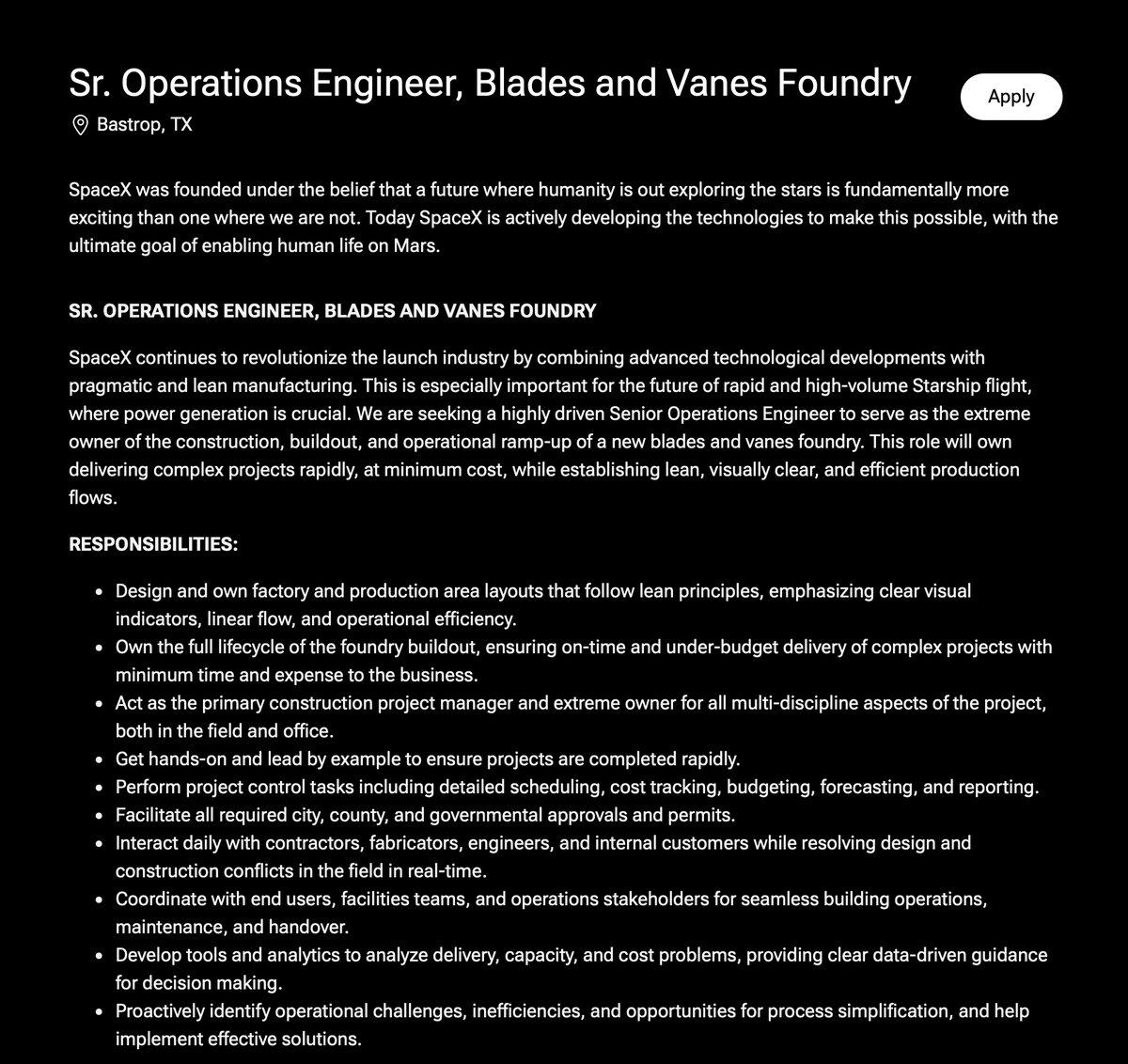
According to a report from The Information, SpaceX is standing up a facility purpose-built to make these components. The plan was already in motion before it became public: SpaceX had posted a job listing for a Senior Operations Engineer to lead a blades and vanes foundry, responsible for the construction, buildout, and operational ramp-up of the plant.

The move follows the same vertical-integration logic that led SpaceX to build its own engines, design its own avionics, and manufacture its own carbon-fiber structures. Third-party aerospace suppliers work on long lead times and conservative design cycles that simply do not match SpaceX's iteration pace.

SpaceX Builds a Dedicated Foundry to Master Raptor Turbine Blades — additional image

Why Owning the Blade Matters

For Raptor — which SpaceX needs in the hundreds to fully outfit Starship — turbine-blade supply is a genuine production bottleneck. A dedicated foundry gives engineers direct control over material composition, casting geometry, heat treatment, and quality inspection. Just as importantly, it lets them iterate on blade design rapidly when a new failure mode appears, rather than waiting months for an outside supplier to produce revised parts.

That control is a strategic asset. When tolerances are this tight, supply-chain dependencies become existential risks, and bringing the work in-house turns a potential vulnerability into a competitive advantage — the same playbook that has powered milestones like the Falcon 9 booster that recently flew a record 37th time.

What It Signals for Starship

Starship's long-term ambitions — Mars settlement, point-to-point Earth transport, and rapid Starlink deployment — all depend on a Raptor engine that can be built reliably and cheaply at scale. Solving blade cracking in the lab is one achievement; producing hundreds of flawless blades a month is a different challenge entirely, and the new foundry is a clear statement that SpaceX views the problem as solved enough to industrialize.

The combination of Musk's candid admission and the concrete steps now underway suggests the company sees turbine-blade production as an asset worth protecting. Whether the foundry comes online in time to feed Starship's next big production ramp will be worth watching. More on the vehicle it will help power is available on SpaceX's official Starship page.