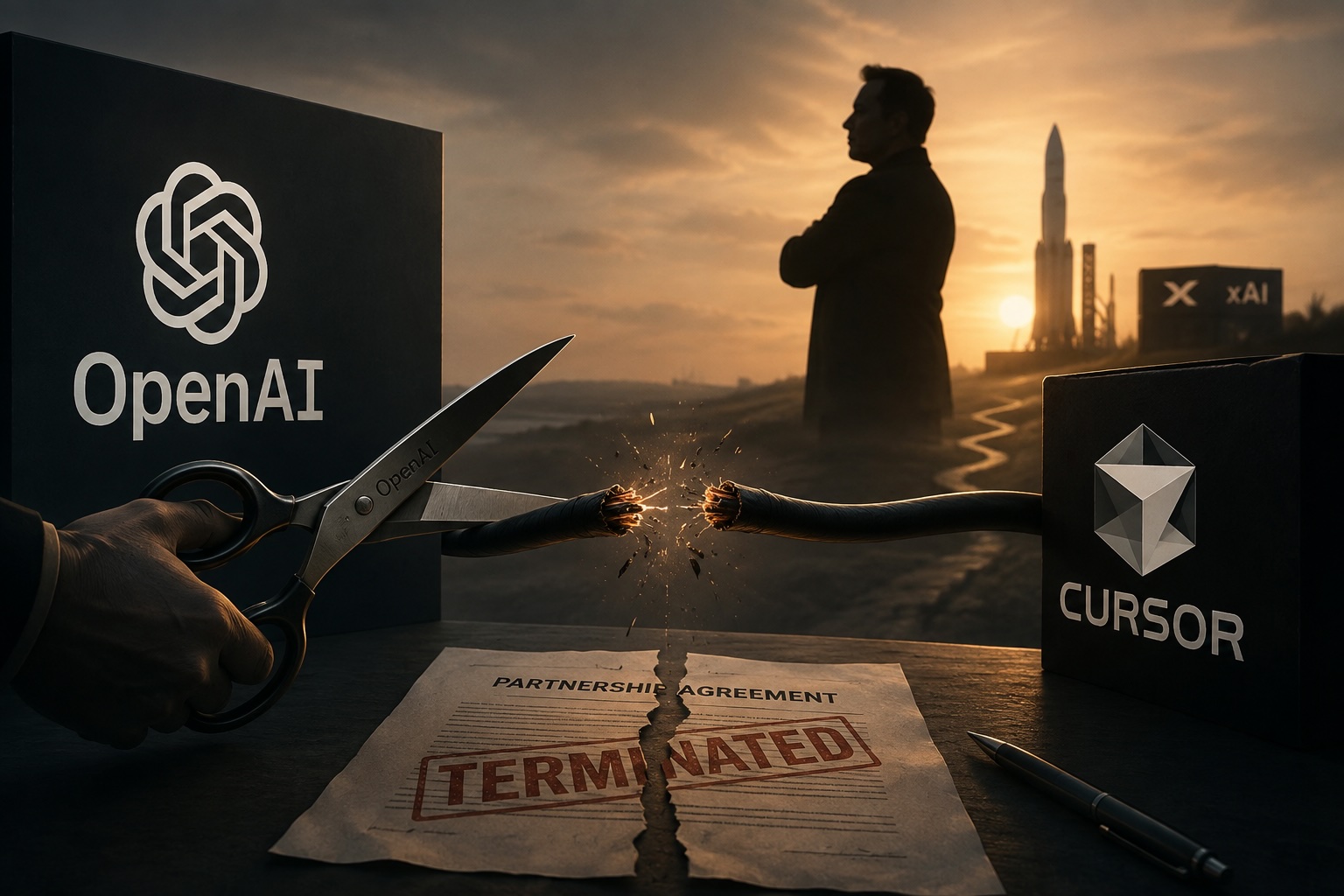
SpaceXAI Leans Into Cursor as Colossus Powers Its AI Push

With Cursor folded into SpaceXAI and the Colossus supercomputer behind it, Elon Musk's AI division is building a vertically integrated coding stack from chips to models.

3 min read
SpaceXAI Leans Into Cursor as Colossus Powers Its AI Push

SAN FRANCISCO — Elon Musk's SpaceXAI division is moving quickly to knit the popular AI coding assistant Cursor into its growing artificial-intelligence stack, two weeks after SpaceX completed its $60 billion acquisition of Cursor parent company Anysphere. The integration gives Musk's team a direct line into one of the most widely used developer tools in the world, and the compute muscle to train models for it in house.

The logic behind the deal is straightforward and, for SpaceXAI, compelling. Cursor had been paying retail prices to outside model providers every time a developer used its product. Now it can tap SpaceX's Colossus supercomputer, roughly the equivalent of a million Nvidia H100 GPUs, to train and serve its own models instead. Cursor CEO Michael Truell now reports directly to Musk inside SpaceXAI, a sign of how central the coding business has become to the plan.

Building an AI Stack From Chip to Code

SpaceXAI increasingly controls every layer of the stack, from the silicon and data centers up through Grok and now a flagship developer application. That vertical integration mirrors the approach that made Tesla and SpaceX so hard to beat in their own markets, and Musk has told Cursor staff he intends to bring the same intensity to AI. The company has been feeding its models an expanding diet of real engineering data, including the SpaceX engineering data now training Grok 4.7, a resource few rivals can match.

SpaceXAI Leans Into Cursor as Colossus Powers Its AI Push — additional image

Colossus Gives Cursor an Edge

Owning the compute changes Cursor's economics overnight. Instead of renting inference from competitors, the tool can lean on Cursor's in-house Composer model, accelerated by SpaceX hardware that was purpose-built for large-scale training. That same infrastructure philosophy is spreading beyond the ground, too: SpaceX has outlined plans for orbital AI data centers under its Starmind program, pointing to a future where compute capacity scales in space as well as on Earth. For developers, the payoff is a coding assistant backed by one of the largest private AI clusters on the planet.

The Road Ahead

SpaceXAI moved fast after the deal closed in mid-August, exercising an option it had secured shortly after its own IPO. Musk has been candid that Grok is still playing catch-up against the AI field, but with Cursor, Colossus and a deepening pool of proprietary data, SpaceXAI now has the pieces to close the gap on its own terms.

The next milestone will be how quickly Cursor's in-house models improve on SpaceX compute. If the integration delivers, Musk will have turned a coding tool acquisition into a self-reinforcing engine, one where chips, data centers, models and applications all push in the same direction.