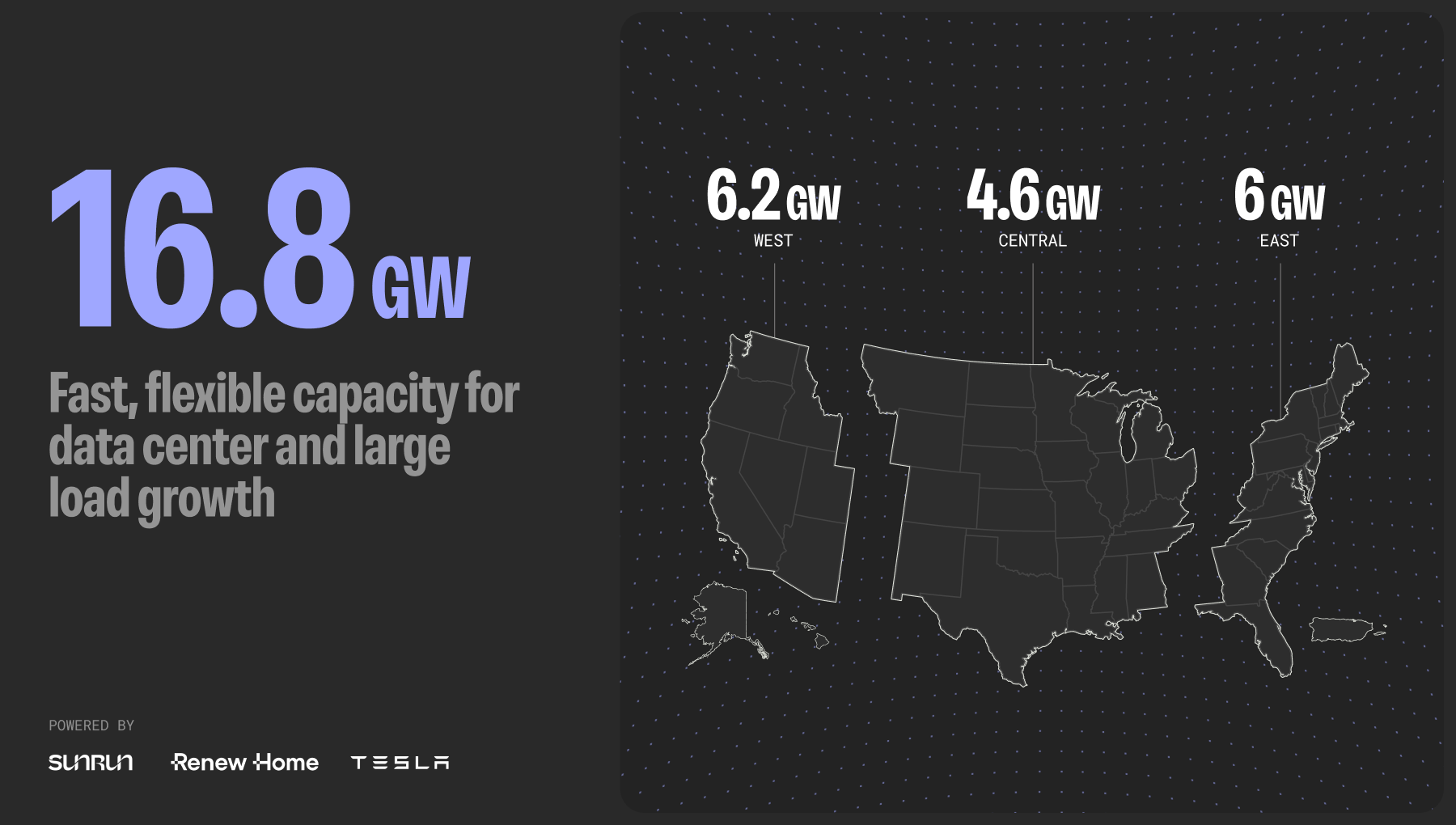
AUSTIN, Texas — Tesla is joining residential solar leader Sunrun and smart-home company Renew Home to pool more than 16 gigawatts of home batteries, thermostats, and connected devices into what the partners call the largest distributed power plant in the United States — and they are pointing all of it squarely at the data centers driving the artificial intelligence boom.
The agreement, announced June 24, aggregates dispatchable capacity from hundreds of thousands of home battery systems run by Sunrun and Tesla, layered with flexible peak capacity from more than 8 million smart thermostats and devices managed by Renew Home. By their own accounting, the coalition can orchestrate roughly 16.8 GW across most major U.S. electricity markets. Wall Street liked the math: Sunrun (RUN) shares jumped as much as 26% on the news.
Power Already Sitting in American Homes
The pitch is built on a simple idea — the cheapest, fastest power plant is the one made of hardware that already exists. "A huge piece of the answer is already in place — in the batteries, thermostats, and electric vehicles inside millions of American homes, waiting to be put to work," said Colby Hastings, Tesla's senior director of residential energy.
That framing fits a strategy Tesla has advanced across its energy business, from grid-scale storage to its own modular AI data-center ambitions. Where utilities take years to permit new transmission lines, substations, and gas plants, the partners say distributed resources can be switched on "in months, not years."
Data Center Alley First
The coalition says it already has more than 300 megawatts ready for immediate deployment in Virginia — the heart of "Data Center Alley" — and expects that to grow as more batteries and thermostats come online. It has also committed capacity to PJM's proposed Reliability Backstop Process, which the companies estimate could unlock over a gigawatt today if accepted.