SAN FRANCISCO — xAI shipped its first developer plugin marketplace for Grok on June 11, giving engineers a way to connect their entire toolchain — databases, deployment platforms, monitoring services, and more — directly into the AI assistant without writing custom integrations from scratch.
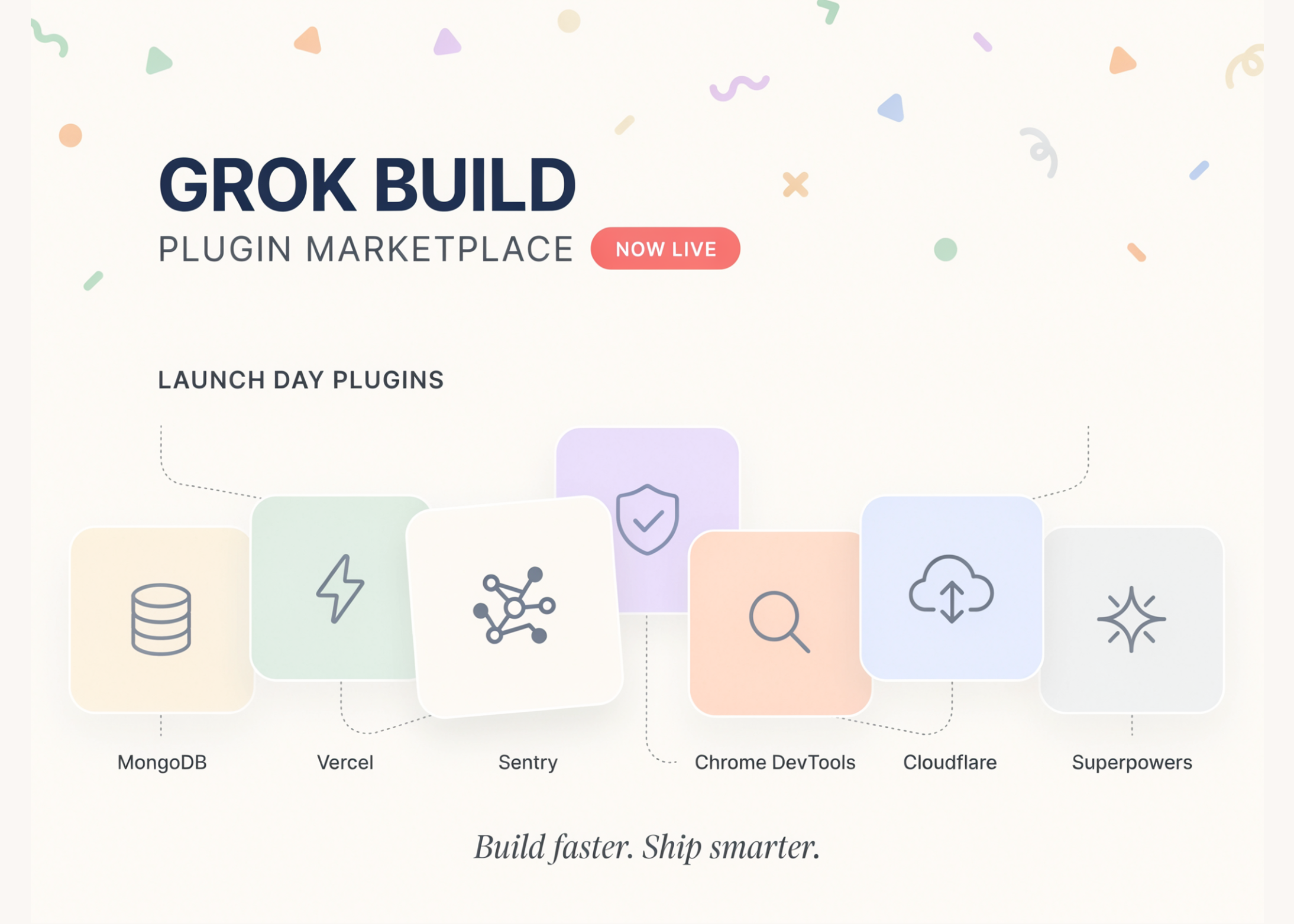
The launch, called Grok Build, arrived with six founding partners: MongoDB, Vercel, Sentry, Chrome DevTools, Cloudflare, and Superpowers. Each plugin extends Grok's ability to take action inside those platforms, letting the model read database schemas, query deployment logs, surface error reports, or interact with browser developer tools in a live session. xAI's rapid expansion into enterprise tooling mirrors its recent move to power eToro's Tori trading agent with real-time X sentiment data.
How Grok Build Works
The marketplace is accessible inside Grok via the /marketplace command. From there, users can browse the catalog and install any listed plugin with grok plugin install <name> --trust. Plugins are not monolithic extensions — they bundle a combination of skills, slash commands, agents, hooks, MCP (Model Context Protocol) servers, and language server protocol (LSP) adapters, depending on what a given integration needs.
Security was a central design concern. xAI built Grok Build around a SHA-pinning model, where every plugin installation is cryptographically tied to a 40-character commit SHA. That means a plugin cannot silently change behavior after installation — any code update requires a new hash, which users must explicitly re-approve. This approach borrows from established supply chain hardening practices common in enterprise software but rarely applied to AI plugin ecosystems.
Open Catalog and Community Submissions
The catalog itself is open. Any developer can submit a plugin by opening a pull request to the xai-org/plugin-marketplace repository on GitHub, making the entire marketplace community-extensible from day one. xAI reviews submissions before they appear in the public index, but the barrier to entry is low compared to locked-down marketplaces that require formal partnership agreements.
This is a meaningfully different posture from closed AI ecosystems and positions Grok as a platform, not just a product. Enterprises that have built workflows around Vercel or Cloudflare can now surface those workflows inside Grok without any additional middleware.
Access and Availability
Grok Build is currently available to SuperGrok and X Premium Plus subscribers. xAI has not announced a timeline for broader access, but the open catalog signals an intent to grow the ecosystem quickly.
The six launch plugins cover enough of a developer's daily stack — shipping, monitoring, storage, and debugging — that early adopters can start building end-to-end workflows with Grok at the center immediately. For companies that already use multiple tools in the launch roster, the full technical specification and plugin submission guidelines are available directly from xAI.
The marketplace launch marks xAI's clearest move yet to position Grok not as a standalone chatbot but as an operating layer that connects and coordinates across a developer's existing infrastructure.