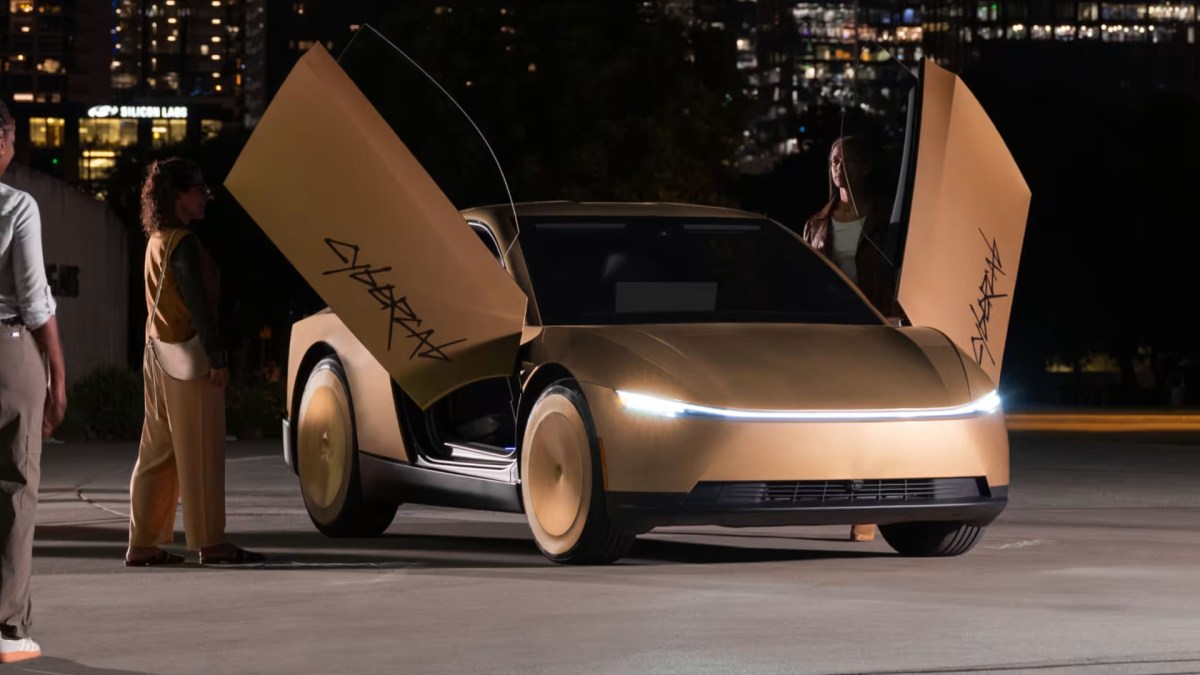
AUSTIN, Texas — Beneath the gold bodywork of Tesla's new Cybercab sits a quiet engineering revolution. The purpose-built robotaxi that began carrying passengers in Austin this week is the first Tesla ever to ship with a full brake-by-wire system and no brake fluid at all — and its drive unit is smaller, lighter and more efficient than anything else in its class.
The details, surfaced at the vehicle's reveal and confirmed by Elon Musk, show a car engineered from the ground up for low cost and near-zero maintenance rather than adapted from an existing platform.
Braking without a single drop of fluid
A conventional car — including every previous Tesla — stops using hydraulics: pressing the pedal pushes fluid through lines to squeeze the calipers. The Cybercab throws that entire circuit away. In its place, sensors read the autonomy stack's braking commands and electric actuators clamp each rotor individually. There is no master cylinder, no plumbing, and no brake pedal to begin with.
For a robotaxi that may run around the clock, the payoff is real. Hydraulic brake fluid absorbs moisture over time and must be periodically flushed — a recurring service cost that simply disappears when there is no fluid. Fewer parts also means fewer failure points and a design that lends itself to fully automated assembly. Independent coverage from The Drive noted the Cybercab is one of the first production cars to ditch hydraulic brake lines entirely, a genuine rarity in 2026.
A drive unit built to be tiny, light and cheap
The Cybercab's motor is just as forward-looking. It uses a simplified bar-wound stator, which packs more copper into the same space to cut resistance and improve cooling, and Tesla says the architecture supports fully automated assembly with sub-10-second cycle times per unit — an extraordinary pace for a component this complex.
The result is a drive unit reported to be 18% smaller and 25% lighter than other top-performing EV drive units, rated at 163 kW (219 hp) in a single-speed, front-wheel-drive layout. Shaving a quarter of the weight out of the drivetrain helps push the Cybercab's curb weight down to roughly 3,110 pounds — remarkably lean for a car carrying this much compute and sensor hardware.
Musk confirms a rare-earth-free motor
Musk added another headline detail this week: the Cybercab's motor contains no rare earth metals while matching the range of rare-earth-dependent designs, something he called "extremely hard to achieve." Removing elements like neodymium without a range penalty is a meaningful win for supply-chain independence and long-term cost — and a hint at where Tesla's future motors may head.
Taken together, the engineering choices tell a consistent story: a vehicle designed to be built by the millions and maintained for pennies per mile. That same relentless focus on manufacturing is visible across Tesla's roadmap, from the robotaxi to the Tesla Semi factory Tesla is preparing to inaugurate in Nevada. The Cybercab may look like a friendly two-seat pod, but under the skin it is a blueprint for how Tesla intends to make autonomy affordable — and it arrives as public riders in Austin are already climbing aboard following the Cybercab's public launch.